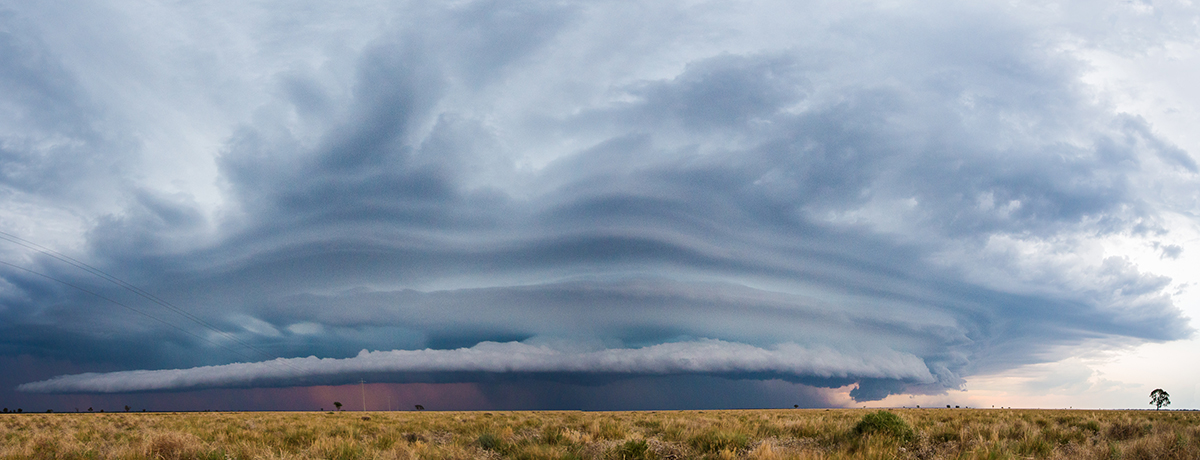
Allen Research Group
Hail - Tornadoes - Climate Variability - Extremes
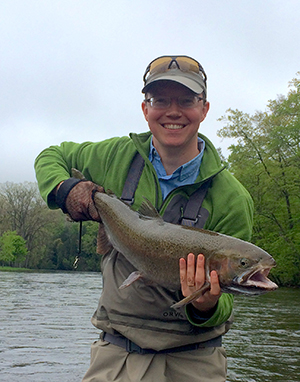
Dr. John T. Allen
Curriculum Vitae Twitterj [dot] t [dot] allen [at] cmich [dot] edu
Dr. Allen is a meteorologist and climate scientist, originally from Sydney, Australia. He completed his B.S. Degree in Earth Sciences (Meteorology and Applied Mathematics) at the University of Melbourne, Australia, and went on to pursue an honors by research in meteorology and subsequently a doctorate at the same institution with support from an Australian Postgraduate Award. From 2013-2016 he completed a three-year Postdoctoral appointment at the International Research Institute for Climate and Society at Columbia University, before promotion to Associate Research Scientist and joined CMU in summer 2016. At CMU he is a Professor of Meteorology in the Department of Earth and Atmospheric Sciences and is coordinator of the Environmental Analytics minor. Previously, he served as Director of the Earth and Ecosystem Science Ph.D. program. Beyond his research at CMU Dr Allen teaches Atmospheric Thermodynamics, Mesoscale Meteorology and Atmospheric Modeling, along with an introductory course on Severe and Unusual Weather. He is also the Associate Director of the NSF Artifical Intelligence Institute for Environmental Sciences (AI2ES) and serves on the ASCE 7 Ch. 36 Wind Task Committee, and serves as an editor for the American Meteorological Society journals Weather and Forecasting (WAF) and Artificial Intelligence for the Earth Systems (AIES).
Dr Allen's research interests span the operational forecasting of severe storms to applied analysis of risk statistics and how these events can be modulated by the climate system. Many of his publications focus on the climatology of historical severe weather events, and the response of these events to climate change and variability. This includes key contributions to our understanding of severe thunderstorms and extreme weather globally. His research and written contributions have been featured in Science, Nature, Scientific American, New Scientist, Climate.gov, Die Welt, The New York Times, The Washington Post, National Geographic, CBC News and ABC Radio National Australia. His work has been recognized by several research awards, including both the Provosts and Presidents Awards for Outstanding Research and Creative Activity at CMU, an early career award from the American Meteorological Society Weather and Forecasting Committee, and an NSF CAREER award. His research draws support from a range of agencies and private industry and includes projects exploring forecasting of severe thunderstorms and hail, climatology and projections under climate change, and application of novel statistical and machine learning methods to characterize atmospheric phenomena (NSF), applying climate information to inform future design standards and codes (NIST), projecting future hazard threats for the insurance industry (AON Inc), and developing information to enhance climate resiliency to extreme precipitation and flooding events in Michigan (DOE). He has co-led two field campaigns; a National Geographic Expeditions Council funded project focusing on novel tornado observations, and the NSF In Situ Collaborative Experiment for the Collection of Hail in the Plains (ICECHIP) field campaign, the first effort to characterize hailstorms over the United States in more than 40 years.
Group Members
Check out our Group Alumni
Opportunities
Opportunities come up regularly! Projects could include those found through the group page, but Dr. Allen is happy to work with students to find other sources of support. Feel free to email Dr. Allen with questions or to express your interest.
Postdoctoral Research Scientists
We are currently recruiting a Postdoctoral Research Scientist.
Graduate Students
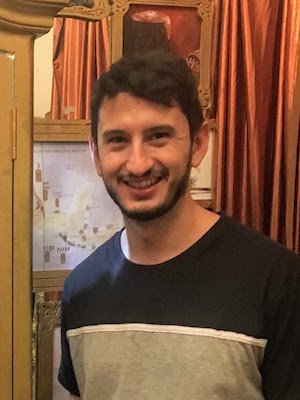
Dr. Carlos Mario Cuervo López
cuerv1cm [at] cmich [dot] edu
Twitter
Carlos joined the group at CMU in Spring 2021, pursuing his Ph.D. in the Earth and Ecosystem Science Program, supported by the NSF CAREER project 'Toward a Global Understanding of Severe Convective Environments' (NSF-AGS1945286). Carlos completed a Bachelors of Civil Engineering, and subsequently a Masters of Engineering in Hydraulic Resources at the Universidad Nacionale de Colombia at Medellin, Colombia. He successfully defended his Ph.D. in Spring 2026, and is currently finishing related publications.
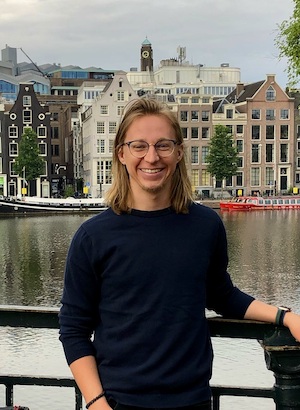
Aaron Zeeb
zeeb1a [at] cmich [dot] edu
Aaron joined the the group at CMU in Summer 2023, pursuing his Ph.D. in the Earth and Ecosystem Science Program, supported by the NSF project 'Developing a Structural, Morphological, and Microphysical Understanding of Left-moving Supercells'. Aaron completed a B.S. in Meteorology with a minor in Geography and a GIS certificate from Northern Illinois University. He has also recently achieved his M.S. in Atmospheric Science from the same institution where his thesis focused on analyzing the historic and projected climatic patterns of supercell precipitation. Aaron's primary research interests revolve around studying the dynamics and variability within severe convective storms, although his interests encompass a broad spectrum of mesoscale phenomena.
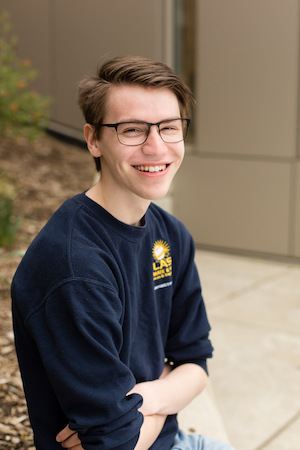
Kaleb Clover
clove1kr [at] cmich [dot] edu
Kaleb joined the group at CMU in Summer 2023, pursuing his Ph.D. in the Earth and Ecosystem Science Program, supported by the NIST Disaster Resilience project 'Quantifying the Risk and Impact of Wind and Hail Storms in a Warming Climate' and 'Quantifying Non-Stationary Tornado Risk in a Warming Climate’. Kaleb graduated from the University of Michigan in 2022 with a BSE in Climate and Meteorology with a concentration in Meteorology. After graduation, Kaleb remained at Michigan to complete a Master of Engineering degree in Applied Climate where he contributed to research using numerical model ensembles to quantify the effects of climate change on extreme precipitation/flooding events. Kaleb’s primary research interests include severe weather climatology, climate extremes, societal impacts, and community resilience.
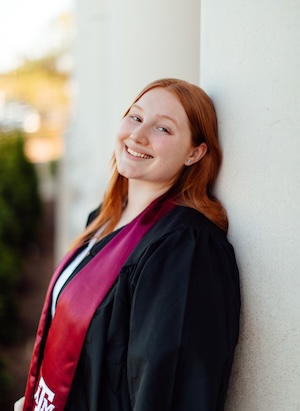
Sabrina Servey
serve1s [at] cmich [dot] edu
Sabrina joined the group at CMU in the Summer of 2025, pursuing her Ph.D. in the Earth and Ecosystem Science Program, supported by the NSF project 'In-situ Collaborative Experiment for Collection of Hail In the Plains (ICECHIP)'. Sabrina led various ground teams (Disdrometer 3 and Hailpad 1) during field operations and is currently analyzing observed hail datasets. For summer 2026 Sabrina led the CMU disdrometer vehicle for TWICECHIP, and is an intern at the Insurance Institute for Business and Home Safety. Sabrina completed a B.S. in Meteorology with a minor in Climate Change at Texas A&M University.
Visiting Scientists and Graduate Students
Visitors are welcome - contact Dr. Allen.
Undergraduate Students
Teagen Schultz
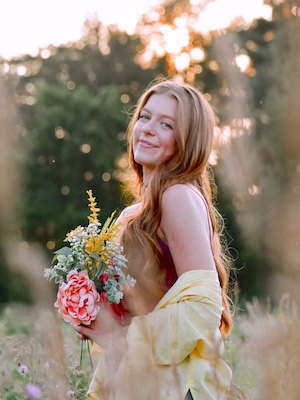
CMU Junior Teagen is working on data collected during the the NSF project 'In-situ Collaborative Experiment for Collection of Hail In the Plains (ICECHIP)'. During ICECHIP, Teagen was involved in the deployment of disdrometers along with collection and measurement of hailstones. For Summer 2026, she was a key member of the team of TWICECHIP, a joint effort with the Insurance Institute for Business and Home Safety (IBHS). For the summer Teagen is an intern at the Insurance Institute for Business and Home Safety.
Grace Parkham
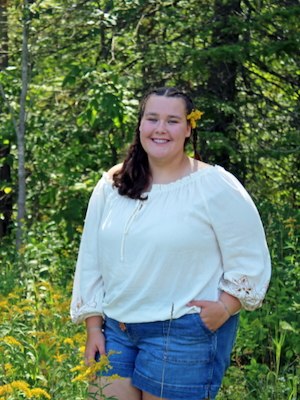
CMU Sophomore Grace is working on data collected during the the NSF project 'In-situ Collaborative Experiment for Collection of Hail In the Plains (ICECHIP)', in particular quality control of collected hail observations, post-processing of GoPro footage and 3D scanning of hailpads. During ICECHIP Grace was involved in the deployment of Windsonds, hailpads and disdrometers, and during TWICECHIP also deployed a high speed hail camera.
Nicholas Kessel

CMU Sophomore Nick is working on data collected during the the NSF project 'In-situ Collaborative Experiment for Collection of Hail In the Plains (ICECHIP)'. During ICECHIP, Nick was involved in the deployment of windsondes, and disdrometers along with collection and measurement of hailstones, and during TWICECHIP also deployed a high speed hail camera.