
| a) dN/dt = rN |  |
b) Nt = N0 e rt |
| c) dN/dt = rN (K - N) / K | |
d) Nt = R0tN0 |
You said that the equation that best represents this type of population growth is,
You said that the equation that best represents this type of population growth is,
You said that the equation that best represents this type of population growth is,
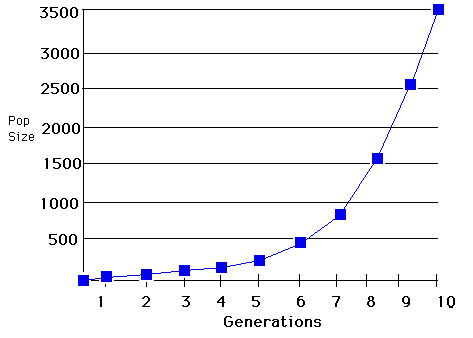
(a) dN/dt = rN.
Well... almost right. This equation describes exponential growth - and the graph represents
an exponential growth curve - but this equation is most appropriate when reproduction is
continuous, rather than occurring in descrete breeding seasons. Also, this equation describes
dN/dt (the population's rate of growth) rather than N (the population's
size) which is what is plotted on the graph. Try again
Click here to return to question 4.
(b) Nt = N0 e rt.
Well... almost. This equation describes exponential growth - and the graph represents an
exponential growth curve - but this equation is most appropriate when reproduction is
continuous, rather than occurring in descrete breeding seasons. Try again.
Click here to return to question 4.
(c) dN/dt = rN (K - N) / K
no, this equation describes "logistic" population growth.
Click here to return to question 4.